
The Indian Designer's Guide to Specifying Green Surface Materials: What E0, Green Pro and VOC-Free Actually Mean
The Indian Designer's Guide to Specifying Green Surface Materials: What E0, Green Pro and VOC-Free Actually Mean
Indoor air quality is the specification concern that most architects know matters, and most still treat as optional. The surfaces specified in a home, office, school or hospital are breathed in every day by the people who occupy those spaces. When surface materials off-gas Volatile Organic Compounds (VOCs), as many standard laminates do, the health implications are real, even if invisible. This guide explains what VOC-free means in the context of surface materials, what the E0 emission rating requires, and how to identify genuinely green products in a market where eco-friendly is often just a label.
What Are VOCs and Why Do They Matter in Laminates?
Volatile Organic Compounds (VOCs) are gases emitted by certain solid materials at room temperature. In conventional laminates, the primary source is phenol-formaldehyde and urea-formaldehyde resins used in the HPL core and bonding layers. When these laminates are exposed to sunlight, heating systems, or normal room temperatures over time, they release formaldehyde and other VOCs into the indoor environment. For residential and healthcare projects in particular, this is not a marginal consideration.
What Is the E0 Emission Rating?
High emission — not recommended for enclosed interior use.
Standard compliance — the minimum accepted in most European markets.
Near-zero or zero formaldehyde emission — the highest achievable standard.
ONEDTL Thermolaminate carries an E0 emission rating, meaning it emits no measurable formaldehyde under standard testing conditions. This positions ONEDTL at the top of the emission performance hierarchy.
What Is Green Pro Certification?
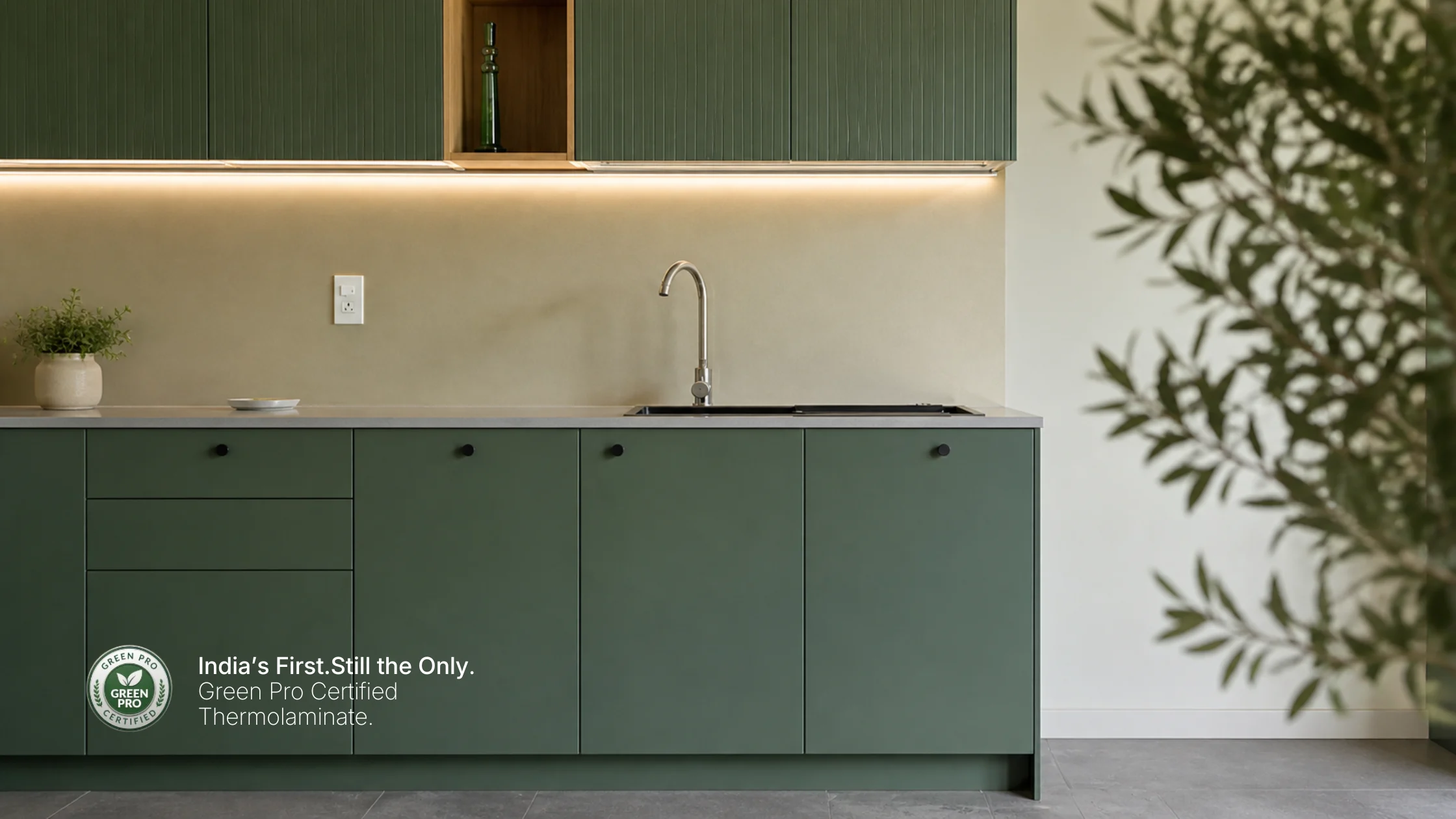
Green Pro is a voluntary green product certification programme administered by the Confederation of Indian Industry (CII). It evaluates products across their full lifecycle, from raw material sourcing to manufacturing processes, product performance, and end-of-life considerations. ONEDTL Thermolaminate is India's first laminate to hold Green Pro certification. This is not a self-declared label; it is a third-party verified credential. For architects specifying for LEED-rated projects or client-mandated green building standards, Green Pro certification provides a documented, auditable basis for the specification.
How This Changes the Specification Decision
A VOC-free, E0-rated surface in a child's bedroom or kitchen reduces the ongoing chemical load in the most inhabited spaces.
Hospitals and clinics that specify ONEDTL gain an antimicrobial surface (99% efficacy, ISO 22196 tested) AND a VOC-free construction, addressing both pathogen and chemical air quality concerns simultaneously.
Green Pro certification provides a documentable contribution to rating systems for architects pursuing LEED, IGBC or GRIHA ratings.
How to Identify Genuinely Green Surface Materials
Not all green claims are equal. When evaluating a surface material's environmental credentials, ask for:
ONEDTL provides all four: Green Pro certification, E0 rating, VOC-free AVC Copolymer composition, and Electron Beam (EB) curing — a process that cures the surface without chemical catalysts.
Conclusion
Specifying surface materials that protect indoor air quality is no longer a premium request from specialist clients. It is becoming the baseline expectation of architects who take their responsibility to building occupants seriously. ONEDTL Thermolaminate was designed to meet this expectation and exceed it: full Green Pro certification documentation, E0 test reports and specification sheets available at designtree.com.